
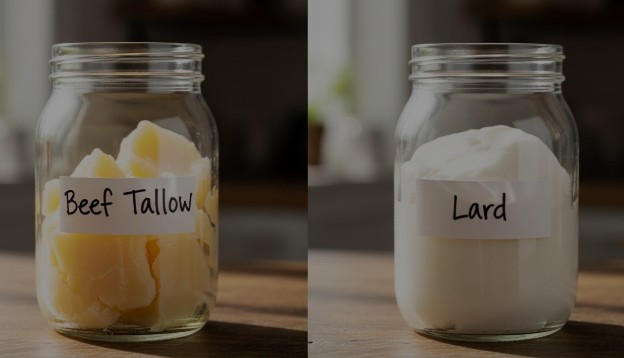
Beef tallow and lard have become increasingly popular in the natural skincare world especially among people seeking ingredient transparency, barrier-supportive moisturizers, and ancestral skincare formulations. But a common question arises: Is beef tallow the same as lard?
The short answer: No. But understanding why they differ is essential if you’re choosing the best fat for your skin barrier, hydration needs, sensitivity level, or DIY skincare formulations.
This comprehensive guide explains every difference between the two, strictly from a skincare perspective texture, absorption, comedogenic rating, skin benefits, irritation potential, fatty acid composition, shelf stability, and more.
The goal: create the most complete skincare-only guide on the internet so users never have to Google this question again.
Let’s begin.
Short Answer: Is Beef Tallow the Same as Lard?
No, beef tallow is not the same as lard.
Beef tallow is rendered fat from cattle.
Lard is rendered fat from pigs.
Although both are animal-derived fats used in traditional skincare, their fatty acid profile, texture, odor, comedogenic rating, and compatibility with different skin types vary significantly.
One-Sentence Differentiation
Tallow is firmer, more skin-compatible, and closer to human sebum, while lard is softer, heavier, and more likely to clog pores.
Quick Definitions
Beef Tallow: A nutrient-dense, stable fat with a sebum-like profile often used in balms, moisturizers, and skin barrier repair formulations.
Lard: A softer, pork-derived fat that can moisturize skin but may be comedogenic, have a more noticeable scent, and cause irritation in sensitive individuals.
Common Misconception
People confuse them because both are animal fats used historically for soap and traditional skincare but scientifically and structurally, they behave very differently on the skin.
What Exactly Are Beef Tallow and Lard?
What Is Beef Tallow?
Beef tallow is rendered from the hard fat found around the kidneys and loins of cattle (often called suet). When gently rendered, it produces a creamy, firm, deeply nourishing fat ideal for skincare.
Source
Derived exclusively from beef fat. Grass-fed tallow is considered the most nutrient-rich option.
Rendering Process
Fat is heated slowly to remove impurities, leaving a clean, stable, neutral-smelling fat perfect for balms and moisturizers.
Historical Skincare Uses
Soothing dry or cracked skin
Traditional salves and ointments
Natural soap making
Wound and chapped skin care
Nutritional Profile for Skin Health
Beef tallow naturally contains:
Fatty acids similar to human sebum
Vitamins A, D, E, K
Conjugated linoleic acid (CLA)
Palmitoleic acid (antimicrobial)
Stearic acid (barrier strengthening)
These make tallow one of the most skin-compatible fats available.
What Is Lard?
Lard is rendered fat from pigs. In skincare, it creates a soft, ointment-like fat that provides occlusion but is not as bio-compatible as tallow.
Source
Derived from pork fat.
Types of Lard (Skincare Context)
Leaf lard: Softer, cleaner, least scent, the type most suitable for skincare.
Back fat lard: Stronger scent, heavier texture.
Commercial processed lard: Often contains preservatives, not recommended for skin.
Nutritional Profile for Skin Health
Lard contains:
Higher monounsaturated fats
Lower saturated fats
Fewer fat-soluble vitamins than tallow
A more occlusive, heavier texture
While moisturizing, it may not mimic human sebum as well as tallow does.
Is Beef Tallow the Same as Lard?
Full Explanation of Differences
Though both are rendered animal fats, they differ in structure, skin compatibility, stability, and nutrient density.
Why People Confuse Them
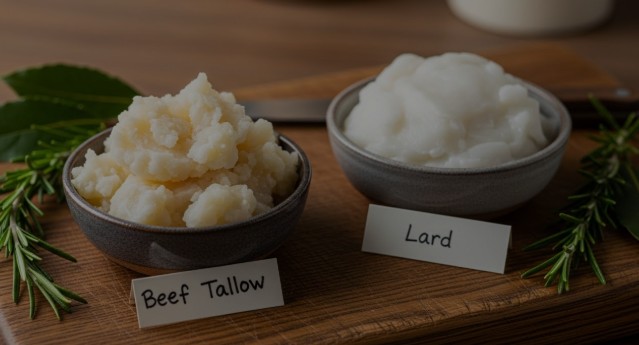
Both are pale solid fats
Both were used historically in skincare
Both can be found in soaps and balms
Similarities
Moisturizing
Occlusive
Provide fatty acids
Natural alternatives to synthetic moisturizers
Key Differences Between Beef Tallow and Lard Explained (Skincare-Only)
Source Differences (Beef vs Pork)
This impacts fat composition and how each performs on the skin.
Flavor & Aroma Differences (Skincare Relevance Only)
Tallow: Mild, clean scent when properly rendered
Lard: More noticeable pork scent, harder to mask in skincare formulations
Skin Absorption & Behavior Differences
Tallow absorbs readily due to its sebum-mimicking profile
Lard sits more on the surface, acting more occlusively
Texture Differences
Tallow: Firmer, ideal for balms and salves
Lard: Softer, more ointment-like, melts quickly
Nutrition & Fatty Acid Profile Differences
Tallow contains more skin-friendly nutrients like CLA and palmitoleic acid.
Shelf Life & Stability Differences
Tallow is more oxidative-stable than lard, making it better for long-term skincare products.
Dietary & Cultural Restrictions (Skincare Context)
Lard is never kosher or halal
Tallow can be sourced halal/kosher
This matters for skincare buyers with strict guidelines.
People Also Ask: Related Questions About Beef Tallow vs Lard (Skincare Only)
Which is better for skin beef tallow or lard?
Tallow is widely considered superior due to better absorption and richer nutrients.
Can you substitute tallow for lard in skincare?
Yes tallow is usually the better choice.
Is beef tallow better for sensitive skin?
Yes, because its structure resembles human skin oils.
Why do some people avoid lard in skincare?
Stronger scent, higher clogging risk, and cultural restrictions.
Which fat is more hydrating?
Lard is more occlusive, but tallow is more nourishing.
Is lard the same as Crisco for skincare?
No Crisco is a vegetable shortening.
Is beef tallow the same as suet?
No suet is the raw fat, not the rendered skincare version.
Does beef tallow or lard smell better on skin?
Tallow has the more neutral, pleasant scent.
Step-by-Step Guide: How to Choose Between Beef Tallow and Lard for Skincare
Step 1 — Determine Your Skin Type
Dry, sensitive, eczema → tallow
Very dry body areas → lard may work
Step 2 — Consider Your Sensitivity Level
Tallow causes fewer reactions in sensitive skin.
Step 3 — Decide How Fast You Want Absorption
Fast absorption → tallow
Slow, heavy occlusion → lard
Step 4 — Consider Texture Preferences
Tallow makes balms; lard makes ointments.
Step 5 — Factor in Nutrient Density
Tallow is richer in skin-friendly antioxidants and vitamins.
Step 6 — Evaluate Shelf Life
Tallow lasts significantly longer crucial for DIY skincare.
Comparison Tables (Skincare-Only)
Table 1: Skin Compatibility Overview
| Feature | Beef Tallow | Lard |
|---|---|---|
| Skin Compatibility | Excellent | Good |
| Irritation Risk | Low | Moderate |
| Suitability for Face | High | Low |
| Suitability for Sensitive Skin | High | Moderate |
| Ideal Skin Types | Dry, eczema, barrier-damaged | Very dry body areas |
Table 2: Fatty Acid & Nutrient Profile (Skin Benefits)
| Component | Beef Tallow | Lard |
|---|---|---|
| Vitamins A, D, E, K | Higher | Lower |
| CLA | Present | Minimal |
| Palmitoleic Acid | Higher | Lower |
| Saturated Fat (Stability) | Higher | Lower |
| MUFAs (Softness) | Moderate | Higher |
Table 3: Skincare Performance
| Performance Metric | Beef Tallow | Lard |
|---|---|---|
| Absorption | Fast | Slow |
| Barrier Repair | Excellent | Good |
| Comedogenic Rating | 2 | 3–4 |
| Ease of Formulation | High | Medium |
| Scent Masking | Easy | Harder |
Table 4: Skincare Texture Comparison
| Texture Trait | Beef Tallow | Lard |
|---|---|---|
| Firmness | High | Low |
| Melting Point | Higher | Lower |
| Feel on Skin | Balm-like | Ointment-like |
| Afterfeel | Non-greasy | Greasy |
| Spreadability | Moderate | High |
Table 5: Storage & Stability (Skincare Use)
| Category | Beef Tallow | Lard |
|---|---|---|
| Shelf Life | Long | Shorter |
| Rancidity Resistance | Strong | Medium |
| Best Storage | Room temp/cool pantry | Refrigerator recommended |
| Oxidative Stability | High | Moderate |
| Ideal for Long-Term Skincare | Yes | Less ideal |
How to Render Beef Tallow or Lard at Home (Skincare Version)
Equipment You Need
Slow cooker
Strainer + cheesecloth
Clean jars
Low-temperature heat source
How to Render Beef Tallow for Skincare
Use grass-fed suet or clean beef fat.
Cut into small pieces for even melting.
Heat on low to avoid scorching.
Strain to remove impurities.
Let cool into a creamy, smooth fat.
How to Render Lard for Skincare
Follow the same steps, but choose leaf lard for mildest scent.
Signs It’s Rendered Correctly
Neutral smell
Pale color
No cracklings or residue
How to Store Homemade Skincare Fats
Store tallow in a cool, dark place; lard may require refrigeration.
Best Uses for Beef Tallow in Skincare
Barrier Repair & Deep Moisturization
Helps restore compromised skin barriers.
Tallow for Extremely Dry or Flaky Skin
Ideal for eczema, psoriasis-prone areas, and winter dryness.
Tallow for Face Creams
Non-greasy finish and excellent absorption.
Tallow for Soaps & Balms
Creates rich, nourishing skincare formulations.
Best Uses for Lard in Skincare
Heavy Occlusion
Creates a seal on the skin for extremely dry areas.
Body-Only Formulations
Better for legs, elbows, and feet than delicate facial skin.
Traditional Salves
Useful in old-fashioned ointment-style preparations.
Mixing with Strong Essential Oils
Its softness makes it easy to blend (not recommended for sensitive faces).
FAQs About Beef Tallow vs Lard (Skincare)
Does beef tallow or lard last longer?
Beef tallow lasts significantly longer.
Does beef tallow or lard smell stronger?
Lard has a more noticeable scent.
Which one is better for sensitive or acne-prone skin?
Beef tallow by a wide margin.
Is lard good for eczema?
It can help with dryness, but tallow is more effective.
Is store-bought lard safe for skincare?
Often not preservatives can irritate skin.
Is beef tallow inflammatory?
High-quality tallow is generally anti-inflammatory.
Does lard clog pores?
It can especially on the face.
Can I use either on my lips?
Tallow is safer and more stable for lip balms.
Conclusion: Final Answer, Is Beef Tallow the Same as Lard?
No beef tallow is not the same as lard, especially when it comes to skincare.
Beef tallow is more stable, more skin-compatible, more nutrient-dense, and has a texture ideal for balms and moisturizers.
Lard is softer and moisturizing but more occlusive, more comedogenic, and more difficult to formulate with and carries cultural restrictions.
If your goal is healthy, nourished, calm, non-irritated skin, beef tallow is the superior skincare fat in nearly every category.